Monday, April 6, 2020

LA JOLLA PLAYHOUSE LITERALLY SOARS WITH THEIR VISUALLY STUNNING MUSICAL “FLY”

Storm Dever as Wendy, and the chorus from
the La Jolla Playhouse production of "Fly". All photos by Kevin Berne.
The La Jolla Playhouse (LJP) has a terrific track record when it comes to producing plays that have binary production values.  By that I mean their first priority is always to the loyal subscription-based audiences.

However, the by-product or bonus in their play season’s selections and productions under the aegis of savvy artistic director Christopher Ashley, always provides a road map toward New York and Broadway when warranted. Their trophy case attests to their many awards for excellence.

Many of Mr. Ashley’s directing productions include: “Memphis”, a red hot musical that successfully made the leap from La Jolla to Broadway running for three years nabbing two Tony wins for Best Musical and for Outstanding Director of a Musical in the process.

In 2017, the heart-warming, inspirational  9/11-infused musical “Come From Away”, transferred its smash-hit La Jolla Playhouse production to Broadway; once again winning Tony Awards for Best Musical, with Mr. Ashley winning another Tony as Best Director.

There’s no doubt about it. Tony Awards are no strangers to the 73 year-old acclaimed La Jolla, California-based theatrical company founded in 1947 by Hollywood actor/stars Mel Ferrer, Dorothy McGuire, and Gregory Peck.

Eric Anderson as Captain Hook faces off against
Lincoln Clauss as Peter in "Fly" at the La Jolla Playhouse
Which brings us to the latest La Jolla Playhouse production “Fly”, a new, visually stunning musical re-imagining of J.M. Barrie’s “Peter and Wendy”, the popular and enduring children’s fantasy story about  adventures in a dream filled place called ‘Neverland’ where children never grow up into adulthood and where each has the ability to fly (with caveats, however, that must be observed).

All children have a secret desire to be able to fly, as do some adults (at least in our dreams).  In “Fly” it’s strictly a kid’s world forever… well, maybe not forever. Remember, as Dorothy says in the Wizard of Oz “there’s no place like home Toto.”

Lincoln Clauss as Peter and Storm Lever
as Wendy in "Fly" at La Jolla Playhouse
I’ve seen at least four or so previous iterations of the “Peter Pan, Wendy, and Captain Hook” story over the years, beginning with the 1954 Mary Martin version through to this 2020 La Jolla Playhouse winning interpretation.  Comparisons are odious at best, however, every revival or re-imagining brings a unique vision of the story to its audience. Director Jeffrey Seller stages his production as one that appeals to both children and adults by infusing his tale with a twist and an underlying celebration of the global feminist-movement.

Wendy becomes the protagonist while Peter is downgraded to a co-protagonist status with Hook remaining the antagonist. Hook now sports ‘mummy’s boy’ vs. complex societal issues. Whether these changes alter the dramatic intention of Barrie's original story version remains to be seen, but hope springs eternal for the purists.

Although it’s a 21st century produced production, there’s nary a line of “questionable dialogue” to be heard. Rare these days from the pens of some playwrights and directors who are determined to break theatre decorum barriers in the name of ‘honesty and the reality in life’.  That being said, I don’t need to experience the reality of a ‘character’ suffering from diarrhea to actually display that action on stage or any other similar character traits in the name of ‘reality’ or ‘truth’; thank you very much.

When inevitable societal changes come, as they must, to audiences of all of the art forms, resistance on the part of the “purists” can be fierce. I’m sure there are some today who would prefer to see Shakespeare performed in an Arden-like forest setting as it was 500 hundred years ago. They forget, however, that all of the roles then were performed by men.  It was English law in the era of the Divine Right of Kings. Thankfully those laws are no longer practiced or viable.  But we live in uncertain and perilous times, so stay tuned.

Eric Anderson as Captain Hook and
the pirate crew in "Fly"at the La Jolla Playhouse.
Today our diversity and gender-bending productions are still not fully embraced.  But they’re catching on especially, with much younger audiences. Diversity and gender-bending casting blessed us with Diane Venora performing as ‘Hamlet’ and most recently, the great English actor Dame Glenda Jackson at the tender age of 82, tackling ‘King Lear’.  Lear is arguably the most physically demanding of all of Shakespeare’s plays.  After all, the character of Lear is ‘crazy’ for most of the play.  Today’s medical analysis would probably say he is suffering from some form of dementia or Alzheimer’s disease.  It takes incredible stamina to perform the role over two and a half hours on stage night after night.

When “King Kong, the Musical” debuted on Broadway in November 2018, I made a pact to review it with my Massachusetts-based theatre critic colleague Charles Giuliano, founder and editor of Berkshire Fine Arts website of which I am a contributing critic.

I was intrigued about how the producers of ‘King Kong’ were going to stage this legendary behemoth of the jungle. The on-stage ‘Kong’ was a 2000 pound, 20 foot tall character/puppet that required a crew of seven to bring him to life every night. The technical obstacles of the production were staggering; nonetheless, ‘Kong’ ran for nine months and it was jaw dropping in its execution.

My thought was to review the production from a ‘technical’ point of view on how the technical aspects enhanced the overall theatrical experience. Charles Giuliano’s thrust would cover the production from the performance assessment of the story adaptation, singers, dancers and actors.  We wrote two separate reviews that appeared in our separate publications.  Mine being the Desert Star Weekly in Palm Spring California as well as on desertlocalnews.com website. Mr. Giuliano’s appeared on Berkshire Fine Arts website in Massachusetts; our collaborative efforts 3000 miles apart worked beautifully.
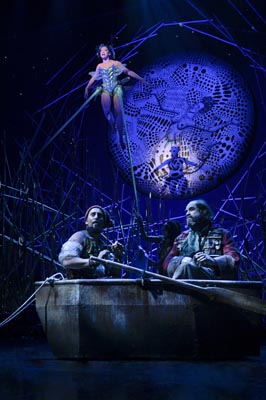
Isabelle McCalla as Tinker Bell, Nahal Joshi as
Smee and Eric Anderson as Captain Hook
in "Fly" at the La Jolla Playhouse
The La Jolla Playhouse production of "Fly" is also a marvel of how creative, skilled technicians can enhance the overall quality and enjoyment of a production by gifted artists. Theatre is a collaborative art form as we all know.  A successful endeavor be it a movie, TV series, a ballet, musicians in the symphony orchestra, or an  opera, in any of the accepted performing arts disciplines knows it “takes a village” to successfully pull it off. The painter and/or novelist and other solitary art form practitioners know they will need the services of that ‘village’ to pull it off later on.

“Fly” is a sensationally performed musical that encompasses all of the components necessary to transfer the show to Broadway; probably they were looking at an October 2020 or February 2021 opening.  The creative team boasts enough Tony-winning and Tony-nominated artists with the energy and horse-power to field a Major League Baseball team. So another La Jolla Playhouse production had its creators packing their bags for Broadway following the LJP run and, then the coronavirus pandemic engulfed the entire globe.

As traditions and budget considerations drive decisions when it comes to Broadway, there will always be creative changes to the incoming Broadway production.  Frankly, as colorful and satisfying as this production is, it’s somewhat over produced. There are a lot of visual pyrotechnics taking place that compete with the lyrics, and the propulsive musical numbers and forward movement of the basic story can lead to disengagement on the part of an audience. It’s also a tad too long; typical running time for Broadway musicals is about two hours, fifteen minutes.

These are fixable issues that director Seller and his creative team of Librettist Rajiv Joseph, Composer Bill Sherman and Lyricists Kristen Childs and Rajiv Joseph, will no doubt judiciously solve before opening night, whenever that takes place. Right now, all theatre productions have been cancelled in California and New York, with more cities and states following suit weekly.

The Peter Pan-Wendy-Tinker Bell-Captain Hook story has been a children’s favorite since its debut more than 115 years ago. Multiple Tony-winning Director Jeffrey Seller is blessed with a cast of some twenty-five plus artists who dance, sing, and perform Andy Blankenbuehler and Stephanie Klemons’ flat-out sensational choreography to the hilt.

Lincoln Clauss as Peter and Storm
Dever as Wendy in "Fly" at the
La Jolla Playhouse
Principle performers, like fetching Storm Lever as Wendy and an assured Lincoln Clauss as Peter Pan, have wonderful on-stage chemistry in their always in-the-moment performances whether ‘flying’ some twenty-five feet above the stage along with Isabelle McCalla as Tinker Bell, eluding Eric Anderson as Captain Hook and Nehal Joshi as his somewhat bumbling second-in-command Smee or outsmarting a very boastful but inept gang of pirates, they make for many laughs and insights.

Director Seller also has his principles performing light-comedy turns instead of the nuanced darker sides of playwright Barries’ story that previous productions have mounted. Liisi La Fontaine, in a strong performance as Crocodile, sports a creative, shimmering dress designed by Tony Award winning designer Paul Tazewell, who does the same costume magic for the ensemble dancers and the pirates. Tony Award winner Howell Binkley’s lighting design allows to us appreciate the amazing aerial designs and choreography of Pichon Baldini, whose balletic-like moves for Wendy, Peter, Tinker Bell, seem natural in their execution of “flying”.  The Music supervision, arrangements and orchestrations are by Will Van Dyke, the Scenic design is by Anna Louizos, with Sound Designs by Nevin Steinberg.

Nehal Joshi as Smee and Eric Anderson as
Capain Hook in "Fly" at the La Jolla Playhouse
It’s a pity that all of this wonderful work and performances won’t be seen as scheduled. However, the health and safety of everyone, both audience and company of performers trumps any entertainment event until this COVID-19 pandemic nightmare memory for some, is declared over. If and when this impressive musical feast for the eyes and ears returns once again to perform at the La Jolla Playhouse, I urge you to attend.  For me this production is one of the most entertaining Wendy/Peter Pan/ Captain Hook productions I’ve seen in a long, long, time.

Remember… a great nation deserves great art.  Support the Arts.

-- Jack Lyons

Monday, March 2, 2020

DEZART PERFORMS OF PALM SPRINGS STAGES THE TRIUMPHANT PULITZER PRIZE DRAMA “SWEAT”

Corydon Melgoza, Theresa Jewitt, Mike Truelock
and Desiree Clarkevin "Sweat" at Dezart Performs
All photos by David A. Lee
Prolific, award-winning American playwright Lynn Nottage, the only female to win two Pulitzer Prizes in drama, is also considered to be one of the most produced playwrights not only in America but across the world.

That being said, how come most audiences don’t quickly recognize her name but always remember what her plays are about?  Perhaps, it’s because Ms. Nottage usually champions the underdog.  She’s ‘David’ in the David and Goliath battles. She exposes the inequities of life and tries to broker the best in all societies with her penetrating and passionate plays.

Those plays revolve around societal issues be it here in the USA with “SWEAT” (her second Pulitzer Prize in 2017) or her set in Africa drama “Ruined”  her first Pulitzer in 2013) that poignantly dealt with the wars and the rape of African women by waring soldiers over the last 20 years.

The subject matter of her plays can be dark, gritty at times, usually centering around the less fortunate among us where the vernacular of the street and its language rules the day. (A note of caution here: there is a plethora of adult language throughout the play with f-bombs being hurled from the stage so leave the kiddies and grandma at home).

Cary Thompson and Mike Truelock in "Sweat"
Not everyone wants to think introspectively about how the sum of society’s parts today illustrates the total problems the world faces in the twenty-first century.  The prospects, for most of us, regarding solutions, are too daunting, with many in denial about the future of America’s workforce.

The story of “SWEAT” takes place in Reading, Pennsylvania, in the years 2000 through 2008, where America’s industrial manufacturing plants are facing ever-increasing layoffs as jobs are moving elsewhere, even overseas.  It’s not a rosy picture.  Many fear the days of the Great Depression of the 1930s and the new mood of Corporate America, where their “bottom-line mantra” of financial belt-tightening policies will return and effect everyone.

 America’s Union movement is coming under increasing attack to accept less in negotiations with management. Most in America’s rust belt communities live from paycheck to paycheck. There are more worker bees than there are management types, with the union caught between these two powerful forces.

“SWEAT” is the compelling story of one such Pennsylvania factory where more friends work on the factory floor as hourly workers, must now come face to face with the inevitability of layoffs that test long-time friendships and even family relationships.

The Dezart Performs production produced by Michael Shaw and Clark Dugger, is brilliantly and seamlessly directed by Shaw.  His directorial vision of how to bring this potent story to the stage of the Palm Springs Woman’s Club is a story in its own right.  Ms. Nottage’s play features a cast of nine characters, each with a compelling story to share with the audience.  The Pearl Mc Manus theatre becomes the arena and a  metaphor for the struggles of all working-class Americas as they try to hang on to their piece of the “American Dream” in perilous times.

The central performing space, wonderfully designed by Thomas L. Valach, takes place in a neighborhood Bar frequented practically every day by the factory floor workers.  It’s so authentic looking in atmosphere, and in execution, there are real beer taps dispensing real beer – the audience applauded when the lights came up.  It’s the workers watering hole of choice where they gather over a beer or a shot of their favorite beverage to unwind, discuss their kids, politics, their fears, and dreams, as well as exchange gossip involving the company management demands of more work for less pay. 

Even though the production is chock full of highly nuanced individual performances by gifted actors, the strength of this impressive production lies in the ensemble performance of the entire company.  Director Shaw becomes the symphony conductor, so to speak, who orchestrates his cast into becoming a finely-tuned performing theatrical instrument.  There isn’t a false note by the actors in this gut-wrenching, blisteringly raw, and powerful drama. Yes, there is a lot of shouting taking place on stage, but the life-altering issues stretch the characters’ emotions to the breaking point.

Corydon Melgoza and Cortez Jackson
in "Sweat"
The outstanding cast includes: Eddie Stephens as Evan, who sets the tone of the production as a parole officer/advisor; Corydon Melgoza as Jason, a troubled society outcast for his many tattoos that adorn his body and for his frequent brushes with the criminal justice system; make him a ticking bomb waiting to explode; Cortez Johnson as Chris, also a past criminal justice system individual who is struggling to return to society; Mike Trulock as Stan, the bartender who runs but doesn’t own the bar, is charged with keeping the peace when things get out of hand as a result of the frustrations his patrons feel over the uncertainty of their jobs and their families.  I don’t know who is responsible for the authentic fight sequence in the Bar area, but it is one of the best-choreographed action scenes I’ve seen in a very long time.

Miguel Arballo as Oscar, the Puerto Rican the all-round bar-factotum employee; Theresa Jewett as factory floor worker Tracey and mother of Jason; Desiree Clarke as Cynthia, and mother of Chris; formerly a factory floor worker, who is recently elevated to be the floor workers Union representative, a step up the ladder that tests the friendship of Tracey, and Melanie Blue as Jessie, a besotted factory floor worker who made alcoholism her best friend as way of dulling the pain of her less than successful life; and a sensational Cary Thompson as Brucie, an addict, and father of Chris and ex-husband of Cynthia.  It’s a cast to die for.

In the technical and creative department led by director Shaw, the production features the incredible set design by Thomas L. Valach, that is enhanced by professional lighting designer Phil Murphy, allowing the costumes designs of Frank Cazares to be fully appreciated, along with the Hair and Make-up designs of Selene Colon and the Sound designs of Clark Dugger, who is also responsible for the informative projection designs that lend an extra element of detail to the production.  Often, attention to detail is what separates a good production from a great production. The Stage Manager is Sierra Barrick.  Well Done All!

“SWEAT” is an absorbing and profound production that grapples with the issues plaguing most of America’s workforce today.  The play performs at the Palm Springs Woman’s Club, in Palm Springs, and runs through March 8, 2020. It’s a Must-See Show! For reservations and ticket information, contact the box office at 760 – 322 – 0179.

-- Jack Lyons

Tuesday, February 25, 2020

PALM CANYON THEATRE STAGES A REVIVAL OF THE ’50’S MUSICAL “THE PAJAMA GAME”

The cast of "The Pajama Game" at Palm Canyon Theater.
All photos by Paul Hayashi.

A September 2018 survey from Matress Advisor, an industry advocate who follows trends in the bed and sleep habits of Americans, found that 67% of American millennials (age 30 and under) sleep in the nude.  The rest of us male Americans, sleep in boxer shorts or briefs, or in the nude, and a few geezers (over 70) still cling to the pajama fashions of the 1940s and ’50s.

So what do these percentages have to do with the state of the American pajama industry?  Frankly, I’m not quite sure other than to discover that, like everything else in our ever-evolving American society, we have a perverse penchant for sharing our personal information with the world.  Facebook, thanks you profusely. You’ve made them the world’s first trillion dollar company on our planet without paying a dime to anyone for that priceless information.

Speaking about pajamas brings us to the Palm Canyon Theatre (PCT) musical production “The Pajama Game” that opened last weekend in Palm Springs. The musical debuted in 1954 on Broadway, as the Korean War was declared over, and pajamas back then was still considered the choice of men’s sleep-ware.

No matter the season on Broadway or theatres across America, ‘ love’ is eternally in the air, pajamas or not, and PCT’s production is no exception. Based on the novel “7 & Half Cents”, by Richard Bissell, the musical is written by Broadway legend George Abbott and novelist Richard Bissell, with music and lyrics by Richard Adler and Jerry Ross, is directed by Richard Marlow.

Jamie Walker Sloane and Nicholas Sloan are
Babe and Sid in "The Pajama Game"
The story celebrates romance, which is blossoming at the “Sleep-Tite Pajama Factory in Cedar Rapids, Iowa.  When new superintendent Sid Sorokin (handsome tenor Nicholas Sloan) arrives to take over the running of the factory, he’s introduced to feisty union rep Babe Williams (a striking blonde Jamie Walker-Sloan), and before you can say “Bob’s your Uncle,” sparks are flying between these two appealing and talented performers.

Babe is a no-nonsense, strong, union leader but is also a female with romantic designs on Sid. Their attraction is mutual, but they land on opposite sides when the union demands that the company management should authorize the raises.  It’s one of the oldest running divides in industrialized societies: Management rights vs. Workers rights, where it takes the wisdom of a Solomon in such negotiations to make everyone happy and show willingness to return to work.

Musical plotlines of 60 years ago generally kept the story relatively simple and easy to follow.  The appeal that audiences were expecting came in the form the music and the lyrics, and the songs that the composers and the librettists provided.  Three outstanding numbers, “Hey There,” “Steam Heat,” and “Hernando’s Hideaway,” came from "The Pajama Game" which also won three Tony’s in the process.

“Hey There” features Sid and Babe in solo performances:  Nicholas Sloan in Act One and Jamie Walker-Sloan in Act Two.  These two talented performers have great on and off-stage chemistry as it turns out they’re married to each in real life, and it shows in their singing and acting numbers. A nice casting touch.

If ever a theatrical company needs a Bob Fosse-inspired dancer/choreographer for a musical/dance production, Anthony Nannini, as Charley, has to be on your wish list.  His execution and precision of Fosse-like dance moves is exciting to watch.  The “Steam Heat” number that begins Act Two is terrifically performed by Nannini and Rob Rota.  Kudos to choreographer Stephanie Eley.  Well Done.

The third number to emerge as an award-winning original number of years ago is performed by the spirited ensemble in “Hernando’s Hideaway”  The ensemble members are energetic even though there are traffic management issues on the small, somewhat cramped, and cluttered acting space designed by Toby Griffin. It’s a minor point, but back-stage actors can be seen moving around off stage by the audience. It’s an easy fix that black cloth curtains can do so as not to break the onstage mood and action.  The main thrust of the production, however, is that the basic human drive for love, romance, and hope is very much worth fighting for and is very much alive in this production.

The musical accompaniment is provided by musical director Phillip Hubler on piano, David Bronson on drums, and Larry Holloway on Bass.

The creative team for “The Pajama Game” led by director Richard Marlow includes the always striking costumes of Uber designer Derik Shopinski, who rarely disappoints with color schemes and colorful costume designs. Another kudo also goes to Wig Designer Mado Nunez for the many styles worn by the female ensemble.  Lighting Design is by J.W. Layne, with sound design by Sean Seymour.

“The Pajama Game” performs at the Palm Canyon Theatre, Palm Springs, and runs until March 15, 2020.  For reservations and ticket information, call the box office at 760-323-5123.

-- Jack Lyons

Thursday, February 6, 2020

DESERT ENSEMBLE THEATRE COMPANY LAUNCHES WORLD PREMIERE OF “ADOPTION ROULETTE”

Fergus Loughnane, Yo Younger
and Adina Lawson in"Adoption Roulette"
Motherhood is a powerful motivator that drives the need for mankind to fulfill its destiny – the propagation of our species.  But the rub of the matter is that some women are barren, unable to have children.  Their only recourse, in many cases, is either to have an in-vitro fertilization procedure or adoption.  Unfortunately, the latter option opens the door for “the charlatans” of the world to take advantage of vulnerable and anxious, naive young couples wanting to become parents.

“Adoption Roulette,” a world premiere play written by Elizabeth Fuller and Joel Vig, seamlessly and artfully directed by Shawn Abramowitz, is produced by Desert Ensemble Theatre Company (DETC) artistic director Jerome Elliott and Shawn Abramowitz.

The powerful drama about foreign adaptions is a true story based on an actual event that takes place in the Winter of 2004, in Weston, Connecticut, Moscow, Russia, and at Vovoysa, an orphanage near the Siberian border.

“Adoption Roulette” is an actors' play. The action takes place on a bare-bones stage with no props or set furniture.  The physical movements in the play are mimed, and the actors play multiple roles.

Yo Younger stars as Elizabeth Fuller, delivering an astonishing portrayal of a woman slowly melting down under the pressure of the fraught situation she finds herself in.  Liz is caught up amid the red tape of a foreign adoption in Russia, without speaking the language.  Remember, in 2004, America is immersed in the Iraq War.  Strained diplomatic relations between Russia and America also doesn’t help Liz without her loving husband Reuel Fuller, being by her side for support.

Fergus Loughnane and Yo Younger
in "Adoption Roulette"
Fergus Loughnane plays Reuel as well as a Delta Airlines pilot, Moscow taxi driver Igor, a Flight Attendant, and a Russian Agency Official. Reuel is frustrated and suspicious with the way the adoption process is going and wants Liz to rethink the adoption with another agency, perhaps at home in the States.  His Russian character accents are spot-on.


Adina Lawson and Yo Younger
in "Adoption Roulette"

Adina Lawson plays Olenka, the sly in-country guide and translator for the Fullers while in Russia. She is also Marion, the Fullers' friend and family lawyer, family friends Lois and Dianne, Orphanage Nurse Blatovsky, and a stern and unhelpful Russian Judge.  Ms. Lawson’s Russian accents are also especially convincing lending authenticity to her Russian characters.


The beauty of this production lies in the strong performances of the actors who play multiple roles.  One can only imagine the mayhem taking place back-stage as they jump from character to character, each requiring different costumes and each looking cool, calm, and unflappable when they do reappear in their scenes.   Kudos to the back-stage dressers that make it all happen.  Bless them all.  These are the magical moments that actors live for.

As the play unfolds, it becomes a bit difficult to accept the incidents being presented on-stage as believable.  The roadblocks erected by non-government private Russian adoption agencies for Americans seeking to adopt Russian children is filled with bureaucratic red tape, frustration, and disappointments, along with deceptive policies that Liz and Reuel face in trying to become parents. One forgets, however, that this is a true story and nightmare experience.

The opening night audience was introduced to playwright Elizabeth Fuller following the performance, who said she enjoyed the show and seeing herself portrayed on the stage by Ms. Younger, adding that it’s all true.  Everyone has a story to tell.  It’s just that some stories are more compelling and frightening to share than others.

Fergus Loughnane, Yo Younger and
Adina Lawson in "Adoption Roulette"
In the technical department led by director Abramowitz, the production is designed by scenic and costume designer Frank Cazares.  The lighting is designed by Ashton Bolanos.  Assistant director Cameron Keys, complete the creative team.  The production is stage managed by Sierra Barrick.

“Adoption Roulette,” is a riveting production that performs at the Palm Springs Woman’s Club on the Pearl McManus stage on Friday, February 7, at 7 pm on Saturday, February 8, (two performances – 2 pm and 7 pm) and Sunday, February 9 a matinee at 2 pm.  For reservations and ticket information, contact DETC by going online to: www.detctheatre.org.

--Jack Lyons

Tuesday, February 4, 2020

CVREP THEATRE LAUNCHES A NEW RE-IMAGINING OF THE MUSICAL PRODUCTION “BALLROOM”

Teri Ralston, Mary Ewing, Leslie Tinnaro,
Juliet Lapointe, Melodie Wolford and Joe Mitchell
in "Ballroom".  All photos by Jim Cox
As theatre and society, in general, evolve, especially here in the United States, “Ballroom,” the new re-imagined musical is a very appropriate production choice for CVREP to present to its 2019/2020 audiences. It’s another crowd-pleasing show that fits the 2019/2020 season theme of “New Beginnings.”

It’s also the boldest and most audacious production in CVREP history. The Cathedral City-based theatrical company headed by Founding Artistic Director Ron Celona, now in its 11th season of producing quality Equity productions here in the Coachella Valley, has become a beacon for more professional actors and creative artists who want work in the Valley’s newest, state-of-the-art theatre complex.

What began as a dream of Ron Celona’s long-held desire to create an Equity Regional Theatre in the Coachella Valley eight years ago is now a reality.  The stakes were high, but the passion and skills, plus hard work and the generosity of some of the Valley’s loyal Patron’s of the Arts, along with Celona’s dedicated and committed Board of Directors has won the day.

The birth and chronology of “Ballroom” is as follows: Born in 1975, it became an Emmy-winning feature film made for TV as a musical starring Maureen Stapleton and Charles Durning.  In the late 1970s, the show was refashioned into a musical play which had a short-lived run on Broadway and was filed away wherever failed Broadway shows go to die.

In 2019, however, artistic director Celona became interested in reviving the project as an updated musical that would make an excellent choice for his CVREP theatre to kick off the 2020 decade.  “BALLROOM,” like the Phoenix rising from the ashes, became a viable project again.

The production features the music of Billy Goldenberg, with a libretto by Jerome Kass, and the lyrics by multiple Oscar, Emmy, and Grammy award-winning songwriters Alan and Marilyn Bergman, under the direction of Ron Celona.

The production boasts a talented cast of twenty-four professional performers ranging in age from 50 to 70, making this entertaining and relevant musical a natural fit that should appeal to Valley audiences of a certain age – that includes both men and women.

The story centers around Bea Asher (a wonderfully sensitive and nuanced performance by Melodie Wolford), who is recently widowed.  Her Morrie (never seen) was her Prince Charming, who did everything for her in his loving and adoring husband way.  But now, Bea must learn to do everything for herself.  It’s a new beginning to Bea’s life that will test her as a respectful widow who now has to carry on with her life.  A life filled with many surprises that lie ahead.

The opening bittersweet number “Who Gave You Permission?” brings lumps and misty eyes to many in the audience.  Its ambivalent lyrics sets a haunting tone, not only to the song sensitively performed by Ms. Wolford, it’s also a definite “grabber number” that should bring every Ladies Club member in the Valley clamoring for tickets to see it.

Bea’s support group to ease her passage as a new widow (actually, Morrie has been gone for over a year) consists of her older, overly protective, tradition-bound sister Helen, played to the hilt by Marcia Rodd.  Almost every family has a relative whose advice is at odds with the feelings of the aggrieved.  After all, they think they’re only trying to help the survivor. Helen’s understanding husband Jack is cleverly and understatedly played by Bill Lewis.

Bill Lewis, Melodie Wolford, Marcia Rodd,
Aviva Pressman and Sean Timothy Brown in "Ballroom"
Bea’s daughter Diane (nicely played by Aviva Pressman), and Bea’s son David, performed by Sean Timothy Brown, are puzzled at Bea’s interest in her newfound group of ladies who gather at the local Bronx dance ballroom; eager to dance, gossip, and get out of the loneliness of their homes every week. They thought their mom wasn’t interested in ballroom dancing anymore.  Ah, adult children… who only see their parents as “parents.”

Bill Nolte and Melodie Wolford in "Ballroom"
What they didn’t see coming, however, was Alfred Rossi, a mild-mannered, shy, caring, mailman tenderly played and sung by Bill Nolte.  It’s easy to see why Bea has a renewed interest in ballroom dancing.  As a couple, Ms. Wolford and Mr. Nolte have nice on-stage chemistry that slowly draws them together, becoming a couple.

Solid supporting performances come from an energetic Angie, Bea’s hairdresser, that is winningly played by Teri Ralston, who first urges Bea to come to the Stardust Ballroom; Pauline, the current reigning Queen of the Stardust Ballroom, is nicely performed by Leslie Tinnaro, who sings and gets to name her choice for next year’s reigning Queen. Her ballroom co-host Artie at the microphone is sung and performed by Randy Brenner.

Angie’s friends and now Bea’s friends include Mary Ewing as Emily; Juliet Lapointe as Martha and Corinne Levy as Shirley. The ballroom performers and dancers feature Douglas Graham as “rubber legs Harry the Noodle”; Nathan Holland as Johnny Lightfeet; Lovely Alessandra Di Pietro as Sandy and handsome Robin Somes as Charley (a look-a-like Yul Brenner) who trip the light fantastic as a dance couple who possess exquisite and athletic dancing moves.

Jitterbug dances, sambas, tango dances. Rumbas and waltzes along with solid dance moves from Anthony Marciona as Petey, and Glenn Rosenblum as Moe, (sporting a Moe Shemp haircut of three stooges fame); from Terry “T-Mac” McLemore; and Lois Bondurich; Olga Morales; Lindsay Ouellette; Wayne Hundley, and Joe Mitchell as Joe the Bartender.  It appears that every bar, tavern, and gin-joint in the world has a Joe the bartender with broad shoulders to lean on and/or a sympathetic ear for listening to the lonely.  Frank Sinatra made millions by singing about those after-hours conversations.

In the technical credits department led by director Celona, two-time Emmy-winning resident design wizard Jimmy Cuomo delivers a breath-taking ballroom set that sports a seven-piece, live on stage orchestra, under the musical direction of Scott Storr.  Designer Cuomo’s New York street backdrop, a small boutique shop, and an interior living room area easily rivals any New York show you can see, but with Celona’s productions, you won’t have to leave the Coachella Valley to enjoy fabulous shows.

Orchestrations for “Ballroom” are provided by Richard Bronskill. The Eleven O’clock spot belongs to a clever, terrific musical number called “Fifty Percent” and the closing number “This Is More Than A Ballroom/I Wish You A Waltz,” both of which are sung by Ms. Wolford and both are winners.

Lighting Designer Moira Wilkie Whitaker provides just the right amount of light to see and appreciate the colorful costumes designed by Frank Cazares (although I’m not too sure about that kaleidoscopic-like cowboy jacket worn briefly by Mr. Brown).  However, the sharp choreography by Jose De La Cuestra neatly fills the stage with flowing movement and graceful dance moves.

“Ballroom” is an impressive and delightful production that will have its audiences smiling as they leave the theatre.  The musical performs at CVREP, Cathedral City, through February 16, 2020. For reservations and ticket information, call the box office at 760-296-2966.

-- Jack Lyons

Saturday, January 25, 2020

STING'S "THE LAST SHIP" SETS SAIL AT THE AHMANSON THEATER


Sting (center) and the cast of THE LAST SHIP at Center Theatre Group's Ahmanson Theater, Los Angeles
All photos by Matthew Murphy
THE LAST SHIP portrays the end of an era in Great Britain when the shipbuilders of Wallsend ultimately went the way of the dinosaurs much like American coal miners in the late 20th century. when overseas shipbuilders could produce a competitive product for millions less with no messy unions to deal with. It eliminated a whole way of life for thousands of workers who struggled to reinvent themselves in an economy that no longer wanted them. Singer/composer/musician Sting created a loving tribute to the town of his youth in England's gritty Northern country. Entire generations of families lost everything...but they didn't go quietly. The battles they fought to take over their shipyard and launch one last ship is the plot of this uneven musical that can't quite decide to go port or starboard.

At the show's opening scene, young Gideon desperately wants to flee the poverty and narrowness of Wallsend and rebels against his father's wishes to join the shipbuilders union. Instead, he impulsively runs off to join the Navy, leaving behind his childhood love Meg whom he promises to return for in a short while.

Frances McNamee as Meg and Oliver Savile as Gideon
in THE LAST SHIP
Seventeen years later, the disillusioned Meg is running a local pub and raising daughter Ellen as a single mum, when Gideon suddenly reappears wanting to reclaim his lost love and discovers he has a daughter. This all happens in the midst of news that the shipyard will be closing and the last ship they are working on, the Utopia, will be torn down and sold for scrap.

Sting as Jackie White in
THE LAST SHIP 
Sting plays Jackie White, the shipyard foreman, who is caught between management and his men. His wife Peggy is the shipyard nurse who stands loyally by her man as the builders and their families turn on Jackie in a rage of betrayal and disappointment.

If it sounds like there is a lot going on here, there is. And each element - plot, music, dialogue, movement - is fighting against each other, much like the characters in the show. The opening number is a rousing sea shanty of sorts, "We've Got Nowt Else" sung full-throttle by the powerful chorus. Starts promising, but then subsequent numbers are alternately Sondheim-esque character pieces, inspiring hymns, jazzy eleven o'clock showstoppers or a plaintive reflection from Sting's classic album "The Soul Cages." In fact, three songs from that album are featured in THE LAST SHIP. This results in a dissonance that often throws the show off balance.

As far as the cast goes, there are some outstanding talents up there, giving it their all. The real find of this production is the glorious Frances McNamee whose tremulous yet powerful voice brings Meg to full life. As her love Gideon, Oliver Savile has a nice presence and shows both the good and bad sides of this prodigal. As Ellen, the feisty young woman who also longs to flee the shipyards like her father did to pursue a musical career, Sophie Reid has a strong voice but seems a bit too mature to be 16 years old. 
Sophie Reid as Ellen in THE LAST SHIP

Other outstanding performers include Jackie Morrison as the no-nonsense wife of Jackie White; Marc Akinfolarin as a philosophizing builder who brings a sweet quality to his scenes; and Annie Grace, channeling her best Margaret Thatcher person as a Baroness who represents the government in the shipyard brouhaha. 

Frances McNamee and the ladies of Wallsend Shipyard
in THE LAST SHIP
But what about Sting, you might be asking, the star and musical creator of THE LAST SHIP? Ironically, he is the least compelling actor on that stage. Don't get me wrong, I adore Sting and when he is performing in concert, he is a magical, magnetic presence. But he's not rough-edged and dynamic enough to portray Jackie. I have a feeling that he agreed to be the marquee name to boost sales for the show, which isn't necessarily a bad thing. But his restrained and erudite way of speaking doesn't really fit the working class Jackie. However, he has the most authentic accent on the stage. Many of the cast members are inconsistent, slipping between Scottish, Irish and a weak attempt at the traditional Geordie accent of northern England.

Kudos to the 59 Productions design team that created the imposing multi-level set using projected images to change scenes and mimic the look of a real shipyard bay. Director Lorne Campbell (who also wrote the revised book) met the challenge of bringing the sound, movement, dialogue and performance elements into a cohesive presentation which was no easy task. Other outstanding production team members include Sound Designer Sebastian Frost, Lighting Designer Matt Daw, Music Supervisor and Orchestrator Rob Mathes, Musical Director Richard John, Costume Designer Molly Einchcomb, and Movement Director Lucy Hind.

While it may not be the grand musical the creators envisioned, it is nonetheless a unique look at a way of life that is no more. THE LAST SHIP is playing at the Music Center's Ahmanson Theater through February 16, 2020. General tickets for “The Last Ship” are available online at CenterTheatreGroup.org, by calling Audience Services at (213) 972-4400 or in person at the Center Theatre Group Box Office.

-- Lisa Lyons


Monday, January 20, 2020

PALM CANYON THEATRE NOW IN ITS 23RD SEASON PRESENTS LERNER AND LOEWE’S “CAMELOT”

Paul Grant as King Arthur and Fabrizio Ibanez
as young Tom of Warwick in "Camelot"
All photos by Paul Hayashi

Although our society and culture is always evolving when it comes to our entertainment choices – theatre, movies, TV streaming platforms, and music – thankfully, there are always the golden oldies that audiences of a certain age cling to and with good reason. They’re familiar; they’re warm, cozy, and deliver music and lyrics to which that age group can understand and relate.

The Palm Canyon Theatre of Palm Springs (PCT), now in its 23rd season of presenting quality entertainment, is producing a revival of Alan Jay Lerner and Frederick Loewe’s romantic fairy tale of King Arthur and the Knights of the Roundtable, based on the T.H. White book “The Once and Future King,” better known as the musical “Camelot.”

Alan Jay Lerner and Frederick Loewe are among Broadway’s music royalty, ranking alongside Rodgers and Hart, then Rodgers and Hammerstein, Cole Porter, Leonard Bernstein, and Stephen Sondheim, among others.  The Broadway theatre was built on the talents of these giants. 

In case one has been living in a cave for the past 60 years, “Camelot” the musical has some of the most iconic music and lyrics found in the American Song Book.  The haunting “If Ever I Would Leave You,” to the clever, wishful thinking, lyrics of the title song “Camelot,” to the poignant “I Loved You Once in Silence,” to the tender “How to Handle a Woman,” have resonated with audiences for six decades.

The Palm Canyon stage production of “Camelot,” is once again awash in the breathtaking colors and costumes created by play director/choreographer Derik Shopinski.  The set by resident design wizard J.W.Layne cleverly reduces the sprawling story to fit neatly within the PCT proscenium walls and stage space. Sound by Brenna Williams and Props by Toby Griffin round out the creative technical team under the direction of Derik Shopinski.

Opening Night can often produce opening night jitters among cast members.  Especially when the production had to share the theatre and performing space with the Palm Springs International Film Festival that uses the PCT venue as a festival screening site, which then shortened the musical’s normal rehearsal time to just thirteen rehearsals.

Sixteen performers bring the production to life for its appreciative audience. The cast presents a broad range of experience and credits to this “Camelot.”  Having said that, the strength of the musical lies in its leading actors:  Garnett Smith brings a wealth of professional credits to his role as the delightful but somewhat dotage-driven elderly King Pellinore, advisor to King Arthur. It’s the type of role that has “scene-stealer” written all over it.  Solid support also comes from Nikki Hock as Nimue/Morgan Le Fay and Noah Arce as Mordred.

A little gem of a performance near the final scene is courtesy of Fabrizio Ibanez as young Tom of Warwick.  It’s a tiny, but important, poignant moment that young Ibanez shares in a scene with Paul Grant’s King Arthur. It’s delivered with just the right amount enthusiasm and understanding for one so young.  TV and the stage may be in his future if he gets bitten by the acting bug.

Jordan J. Jones as Lancelot and Nikki Hock as
Nimue/Morgan Le Fay in "Camelot"
Jordan J. Jones as Sir Lancelot, (originally a role made famous by Robert Goulet), is a singer who acts and gets to fall in love (lucky fellow) with the fairest maiden in the land of Camelot, Queen Guenevere, the beautiful wife of King Arthur Pendragon, who is played by Se Layne.

The last time I saw Ms. Layne, on stage, she was tutoring the children of the King of Siam in the musical production “The King and I” at PCT.  I stated then that the role of Anna was a role she was born to play. I may have misspoken myself.  The beautiful Ms. Layne is on a roll with back to back winning performances.  She easily slips from young maiden into a coquettishly young adult, to a desirable Queen.  It’s another finely judged performance from Ms. Layne, who stars in a role that features her classically trained voice once again (lucky audience).

Paul Grant as King Arthur and Se Layne as
Guenevere in "Camelot"
As King Arthur, Mr. Grant brings his extensive credits in New York, along with his many national touring company roles, to the Palm Canyon stage once more.  His energy and on-stage chemistry with his co-star Ms. Layne underscores the standards that these two professional performing actor/singers bring to their roles of King Arthur and Queen Guenevere. 

The musical production, once again, is under the musical direction of Steven Smith, on piano with accompaniment by David Bronson on drums and Larry Holloway on string Bass.

“Camelot” performs on the Palm Canyon Theatre stage and runs through February 9, 2020.  For reservations and ticket information, call the box office at 760-323-5123.

-- Jack Lyons